


Be the first to review “How Machine Learning Classification Accuracy Changes in a Happiness Dataset with Different Demographic Groups” Cancel reply

How Machine Learning Classification Accuracy Changes in a Happiness Dataset with Different Demographic Groups
$1,700.00

How Machine Learning Classification Accuracy Changes in a Happiness Dataset with Different Demographic Groups
$1,700.00
Research Materials Available – Subject to Confirmation
- Design & Schematics
- Code
- Simulations
- Documentation
Research materials: Availability, pricing, and conditions will be checked. Then, a detailed offer will be provided. Please note: Availability and pricing are subject to author confirmation.
Vendor Information
- No ratings found yet!


Related products
- Add to WishlistAdd to Wishlist



 Functional Design Employing Miniaturized Electronics with Wireless Signal Provision to a Smartphone for a Strain-Based Measuring System for Ski Poles
  A Novel Telerehabilitation System for Physical Exercise Monitoring in Elderly Healthcare
  Learn2Write: Augmented Reality and Machine Learning-Based Mobile App to Learn Writing
  Generating contextual help for user interfaces from software requirements
  A Federated Learning Framework for Enhanced Data Security and Cyber Intrusion Detection in Distributed Network of Underwater Drones
  Analysis and Design of Multiport Converters for Photovoltaic and Electrical Vehicle Applications Electrical Vehicle Applications
  Application of Unsupervised Multivariate Analysis Methods to Raman Spectroscopic Assessment of Human Dental Enamel
  Proposed framework for planning software releases using fuzzy rule-based system
  A Pre-Activation Residual Convolutional Network With Attention Modules for High-Resolution Segmented EEG Emotion Recognition
  State of runtime adaptation in service oriented systems: what, where, when, how and right
  Requirements knowledge acquisition from online user forums
  Perceptions about the Future of Integrating Emerging Technologies into Higher Education—The Case of Robotics with Artificial Intelligence
  Assessment of Rear-End Collision Risk Based on a Deep Reinforcement Learning Technique: A Break Reaction Assessment Approach
  An Expository Examination of Temporally Evolving Graph-Based Approaches for the Visual Investigation of Autonomous Driving
  A Comprehensive Review on Sensor Fusion Techniques for Localization of a Dynamic Target in GPS-Denied Environments
  Combining genetic algorithm and pairwise testing for optimised test generation from UML ADs
  Achieving Faster and Smarter Chest X-Ray Classification With Optimized CNNs
  Automated Internal Defect Identification and Localization Based on a Near-Field SAR Millimeter-Wave Imaging System
  Emotion Transfer for 3D Hand and Full Body Motion Using StarGAN
  A Modified WASPAS Method for the Evaluation of E-Commerce Websites Based on Pythagorean Fuzzy Information
  Digital Game-Based Support for Learning the Phlebotomy Procedure in the Biomedical Laboratory Scientist Education
  An OFDM Signal Enhancement and Demodulation Method Based on Segmented Asymmetric Bistable Stochastic Resonance
  A Highly Adaptive Oversampling Approach to Address the Issue of Data Imbalance
 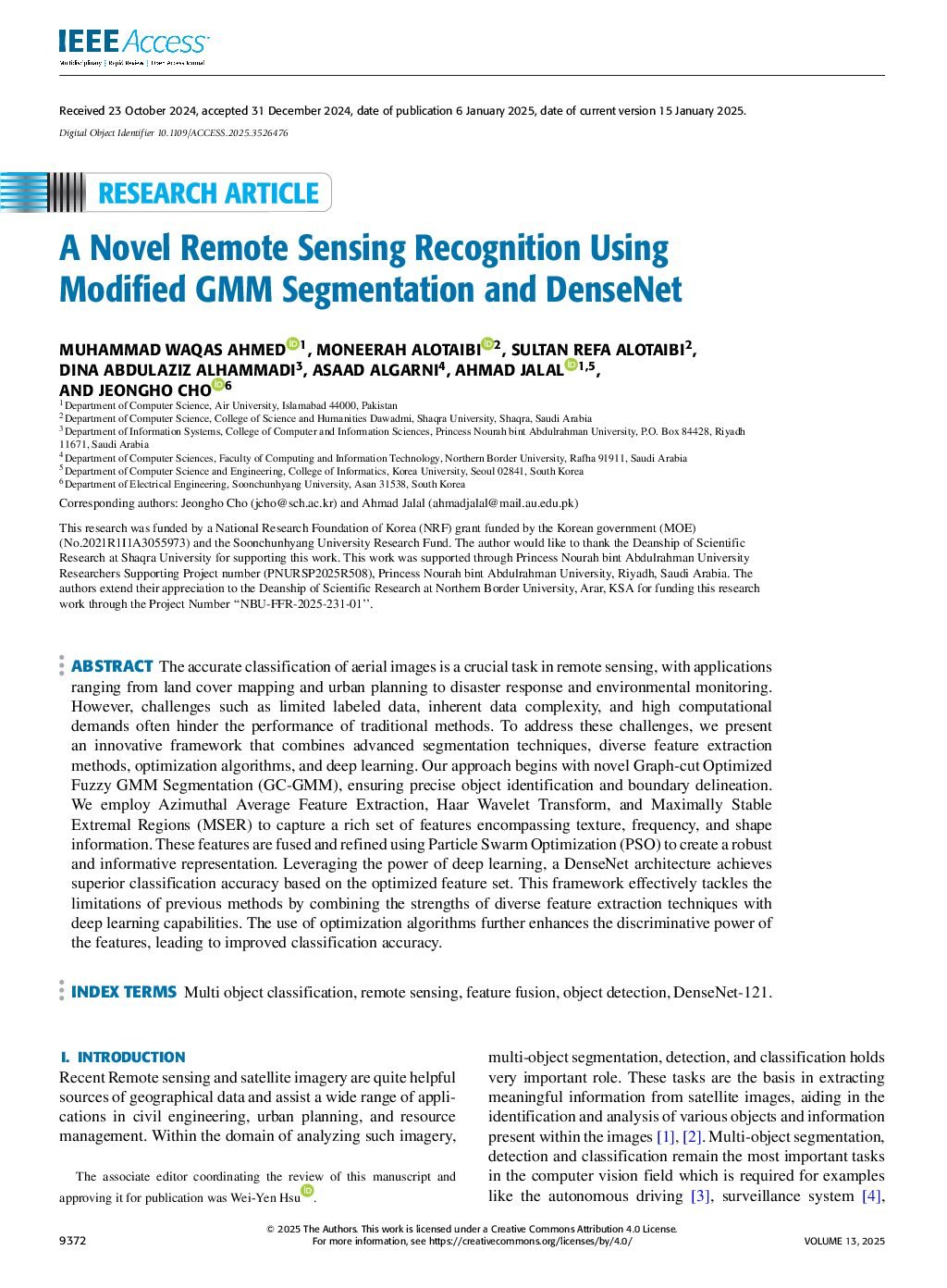 A Novel Remote Sensing Recognition Using Modified GMM Segmentation and DenseNet
  Simulation and Analysis of Self-Replicating Robot Decision-Making Systems
  Design of CAN Bus Communication Interfaces for Forestry Machines
  Markerless Dog Pose Recognition in the Wild Using ResNet Deep Learning Model
Reviews
There are no reviews yet.